


OTR - Offroad Car Driving Game
DogByte Games
I usually know within the first few minutes whether an off-road driving game has a satisfying rhythm or is simply throwing vehicles across rough-looking terrain. OTR - Offroad Car Driving Game makes a good first impression because its appeal is easy to understand: pick a vehicle, find a difficult route, fight the landscape, and try again when the terrain wins. It is a free racing game from DogByte Games, designed around open-world off-road driving rather than clean circuits and perfect racing lines.
That difference matters. This is not the kind of racer I open when I want a short, polished lap against identical opponents. I play it when I want to explore, make a poor decision on a muddy slope, recover from it, and immediately attempt the same climb with a better approach. The driving feels more like a sequence of small problems than one continuous contest. Every hill, jump, narrow path, and awkward landing asks me to adjust speed, direction, and patience.
The game has clearly found a large audience: it carries a 4.5 average from around 516 thousand ratings and has passed 100 million installs. Those figures do not automatically make it right for everyone, but they do fit my experience of a game that is easy to start and difficult to put down once a route becomes personal. I kept returning not because every attempt was successful, but because failure usually showed me something I could change.
Related News
How OTR - Offroad Car Driving Game Builds Community Through Shared Driving Stories

Why Dr. Driving Makes Precision the New Mobile Racing Skill
From the first climb to the next attempt
The first action is choosing how much control to use
The first useful decision is not simply which direction to drive. It is how aggressively to approach the terrain. A steep rise may look like a place for maximum throttle, yet charging into it can leave the vehicle badly positioned or unable to recover. I get better results by reading the slope before committing, lining up the vehicle, and treating momentum as something to manage rather than spend immediately.
That makes the opening minutes more interesting than a standard arcade race. There is no need to memorize a track before having fun, but the landscape rewards attention. I can take a direct route and risk a reset, or spend longer searching for a gentler angle. The second option often feels slower while I am doing it, though it can be much faster than repeatedly attacking the same obstacle without changing my approach.
Related News

Why WhatsApp Messenger Still Makes Everyday Communication Feel Easy

Jurassic World: The Game Is the Better Dino Tycoon for Strategic Players

Threads in Real Life: Who Should Join, Lurk, or Leave

How SHEIN Turned Shopping Into an Endless Content Feed

How to Make Fortnite Feel Smarter on Mobile

Should You Switch to Microsoft Outlook on Mobile?
Controls are most comfortable when I make small corrections. Oversteering is an easy mistake, especially when the vehicle is already sliding or bouncing. I prefer to use short steering inputs, release the accelerator briefly before a difficult landing, and avoid treating every problem as a reason to accelerate harder. That habit is one of the first practical lessons the game teaches without spelling it out.
For a realistic everyday session, I can imagine opening it while waiting for an appointment and setting myself one modest goal: reach a visible ridge, recover a vehicle from an awkward position, or complete a route without rushing. The game works well in that situation because the objective can be self-imposed. I do not need a long uninterrupted evening to enjoy a few attempts, although a particularly stubborn climb can easily extend a short break.
Why the driving feedback keeps me involved
The most appealing part of the driving is the immediate connection between my input and the vehicle’s changing position. A bad line is visible quickly. I can feel when I have approached a rise too quickly, turned too sharply, or landed in a way that has made the next move harder. That clarity gives mistakes value. I am not merely losing; I am collecting information for the next attempt.
Gallery
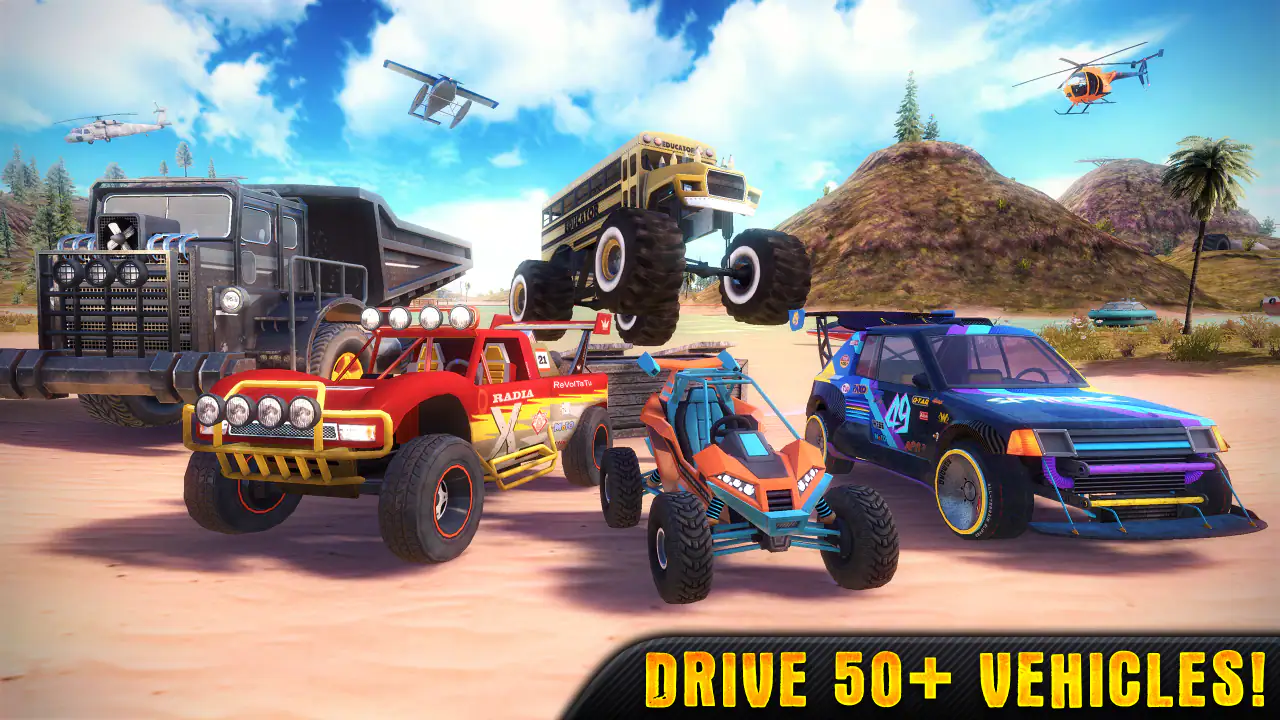
The feedback rhythm is built from action and consequence. I press forward, watch the vehicle climb or slip, correct the steering, and decide whether to continue or recover. When the vehicle clears an obstacle, the reward is not only progress. It is confirmation that the chosen angle and speed were right. When it fails, the reset is less frustrating because the cause is usually understandable.
That rhythm separates this game from many conventional mobile racing alternatives. A typical track racer gives me a defined course, rivals, lap positions, and a finish line. Those games are better when I want competition to provide the pressure. Here, the terrain is the opponent. The challenge is quieter but more personal: can I make this vehicle work in a place where my previous attempt failed?
The open-world structure also changes how I think about progress. Instead of following one obvious racing line, I can look around and decide what seems reachable. Exploration becomes part of the challenge, and getting temporarily lost is not always a problem. Sometimes the wrong turn reveals a more interesting route or a new obstacle worth testing. The trade-off is that players who need constant direction may find the freedom less satisfying than a clearly staged race ladder.
Small driving habits that make a real difference
One useful habit is to separate scouting from commitment. I often approach a difficult section slowly first, looking at the slope and the space available beyond it. If the landing area is poor, I would rather reposition before climbing than discover the problem at the top. This sounds obvious, but the game’s tempting open spaces encourage impulsive driving, and that is where many unnecessary recoveries begin.
A second habit is to treat recovery as part of the route instead of an embarrassing interruption. When a vehicle ends up sideways or loses its line, panicking usually makes the situation worse. I pause, identify the direction that gives the tires room, and try to create a stable position before accelerating. This approach is especially useful when I am close to a difficult section and do not want to abandon the attempt too quickly.
I also find it helpful to change one variable at a time. If I alter the route, speed, steering, and vehicle choice all at once, I learn very little from success or failure. Keeping the route constant while changing my approach gives the game a more deliberate, almost puzzle-like quality. It is one of the less obvious strengths of the driving model: the open terrain supports experimentation rather than only reaction.
Players should also expect the camera and terrain to create moments where the best route is not immediately obvious. A hill can hide the landing area, and a seemingly safe shortcut may become awkward once the vehicle reaches its narrowest point. I do not consider that a flaw by itself, but it means the game rewards looking ahead. If I want a racer where the next turn is always visible and perfectly signposted, another style of game will be more comfortable.
The reward is mastery, not just reaching a destination
Progress feels most rewarding when I solve a problem that previously looked impossible. Clearing a slope after several failed attempts creates a stronger sense of achievement than simply finishing an easy route. The reward comes from remembering what went wrong, adjusting the approach, and seeing the vehicle respond differently. That is why the game can remain engaging even when I am not chasing a formal leaderboard position.
Vehicle choice adds another layer to that feeling. I do not think of a vehicle as automatically making the game easy; it changes how I approach the terrain. A vehicle that feels stable can encourage careful exploration, while a more lively one may make jumps and recoveries more demanding. The important point is that changing vehicles can refresh a familiar area. I may know the route, but I do not necessarily know how the next vehicle will behave on it.
The reward loop is therefore practical: action leads to feedback, feedback produces a lesson, and the lesson improves the next attempt. That is a stronger foundation than a simple stream of unlocks because it gives me a reason to care about technique. Still, players who prefer rewards that arrive quickly and visibly may find the slower satisfaction less exciting. The game asks me to value improved control, not only a new item or completed event.
There is also a sensible reason to be careful with spending. The game is free to download, with in-app purchases ranging from $0.99 to $54.99 per item. I would begin without paying and first decide whether the driving loop itself suits me. If I enjoy experimenting with terrain, optional spending may feel more meaningful later; if I am already frustrated by repeated failures, buying something will not necessarily solve the underlying issue that my approach needs changing.
Resetting without losing the reason to continue
A good reset should feel like a doorway to another attempt, not a punishment that ends the session. That is where this game generally works for me. After a failed climb or awkward landing, I already have a hypothesis for what to do differently. The reset has a purpose because the failure was connected to an action I controlled.
My usual reset routine is simple. I first identify the exact moment the attempt went wrong, then I decide whether the problem was speed, angle, positioning, or impatience. On the next run, I change only that part. This keeps the repetition from becoming mindless. If I fail in the same way several times, I stop forcing the route and search for another line instead. The open-world setting makes that change of plan feel natural.
There are limits to this loop. When I am tired, I am more likely to repeat the same mistake and blame the terrain. The game can expose that impatience because it does not always give me the dramatic reward of a race finish. A short session is enjoyable when I set a clear target, but an unfocused session can turn into aimless driving followed by avoidable resets.
That is also why it is not the right choice for every racing fan. Someone looking for licensed cars, tightly designed circuits, realistic competition, or a strong emphasis on head-to-head racing may prefer a conventional racer. Someone who dislikes slow exploration and vehicle recovery should probably skip it. The game’s appeal depends on enjoying the process of figuring out terrain, not merely being told who won.
Who will get the most from this off-road game?
I recommend it most to players who like driving games with room to experiment. It suits people who enjoy finding their own routes, learning through failed attempts, and turning a difficult obstacle into a personal challenge. It is also a good fit for casual players who want an experience that can be played in short bursts but still offers enough depth to reward longer sessions.
It works particularly well for younger players and families because its content rating is Everyone, though adults should still remember that optional purchases are present. The minimum operating-system requirement is Android 5.0, which makes it accessible on a broad range of Android devices. Actual comfort will still depend on the phone or tablet, especially when a player wants responsive control during demanding sections.
I would be more cautious recommending it to someone who wants a completely passive mobile game. The driving requires attention, even when the session is relaxed. Small corrections matter, and the game is more enjoyable when I engage with the vehicle’s movement instead of holding one direction and hoping the landscape cooperates.
It is also worth knowing what kind of variety matters to you. If variety means many tightly authored race events with constant changes in opponents and rules, this may feel less structured. If variety means different terrain decisions, routes, vehicle behavior, and ways to approach an obstacle, the open setting has more to offer. That distinction is more important than simply asking whether the game has a lot to do.
How it compares with ordinary mobile racing
Compared with a lap-based arcade racer, this game gives up some immediacy in exchange for freedom. There may be less pressure from a countdown or rival pack, but there is more room to make a route your own. I spend less time watching a position indicator and more time judging the ground directly in front of me.
Compared with a realistic driving simulator, it is easier to pick up and more focused on the pleasure of overcoming terrain than on reproducing every part of road driving. That makes it friendlier for casual play, though simulation fans may find the experience less precise or less serious than they want. Compared with a pure stunt game, it offers more reason to think about approach and recovery instead of treating every jump as a one-off spectacle.
The unusual trade-off is that the game can feel both relaxing and demanding. Exploring an open area at a comfortable pace is calming, but a single steep obstacle can require concentration and several retries. I like that contrast, although it means the tone is not as predictable as a straightforward race. I may begin with casual driving and end up focused on one climb for far longer than planned.
My verdict on the action-feedback-reward loop
After spending time with it, I see the core loop as the game’s strongest reason to install it. I take an action, receive immediate feedback from the vehicle and terrain, earn progress or a useful lesson, reset after failure, and begin again because the next attempt feels informed rather than random. That structure is simple, but the open-world setting gives it enough room to stay interesting.
The best reason to play is the feeling of turning a failed climb into a solved problem. The weakest part is that players who need constant competition or clearly staged goals may find the pace too loose. I also recommend keeping spending secondary until the basic driving has earned your interest; the game is most convincing when its handling and terrain already make you want another attempt.
DogByte Games has made a free racing game that is less about perfect laps and more about persistence, positioning, and curiosity. With a 4.5 average and over 100 million installs, it is clearly established, but my recommendation rests on the moment-to-moment experience rather than its popularity. If you enjoy off-road exploration and do not mind learning through resets, OTR - Offroad Car Driving Game is an easy one to try. If you want a tightly controlled competitive racer, I would choose a different option before spending time or money here.
FAQs for OTR - Offroad Car Driving Game
What is OTR - Offroad Car Driving Game about?
OTR - Offroad Car Driving Game is an exciting driving simulation that immerses players in rugged terrains and challenging environments. The game offers a variety of vehicles to choose from, each with unique handling and capabilities, allowing players to explore vast open-world settings. It’s designed to test your driving skills across different off-road tracks.
What platforms is OTR available on?
OTR - Offroad Car Driving Game is available for both Android and iOS devices. You can download it from the Google Play Store or Apple App Store. It ensures a smooth gaming experience on most modern smartphones and tablets, but it's always a good idea to check system requirements before downloading.
Does OTR offer multiplayer modes?
Yes, OTR - Offroad Car Driving Game includes multiplayer modes, allowing you to compete with friends or players worldwide. This feature enhances the gameplay by introducing competitive elements and the opportunity to showcase your off-road driving prowess in real time against others.
Are there in-app purchases in OTR?
OTR - Offroad Car Driving Game does offer in-app purchases. Players can buy additional vehicles, upgrades, or customization options to enhance their gaming experience. While the game is free to download, these purchases can provide significant advantages or aesthetic improvements in the gameplay.
What are the main features of OTR?
OTR boasts a range of features including realistic physics, a variety of off-road vehicles, and expansive open-world environments. Players can enjoy diverse weather conditions and day-night cycles, adding to the realism. The game also includes a customization feature, allowing players to modify their vehicles to better tackle challenging terrains.
Pros
- Realistic off-road physics enhance gameplay.
- Wide variety of vehicles to choose from.
- Stunning graphics with detailed environments.
- Customizable controls for personalized play.
- Challenging missions keep users engaged.
Cons
- Occasional in-app purchase prompts.
- High battery consumption during play.
- Limited multiplayer options available.
- Some ads interrupt the gaming experience.
- Requires a stable internet connection.


